
The Equifax Catastrophe: How One Missed Update Became a $700M Fine In most workplaces, ...
A Complete Guide to Policy Acknowledgment (and What Happens When Deadlines are Missed)
When running a business, some administrative processes easily fall by the wayside. One critical process that is frequently taken for granted is policy acknowledgment.
While it usually takes just a few minutes, ignoring it can leave your company exposed to massive operational and legal risks.
What is policy acknowledgment?
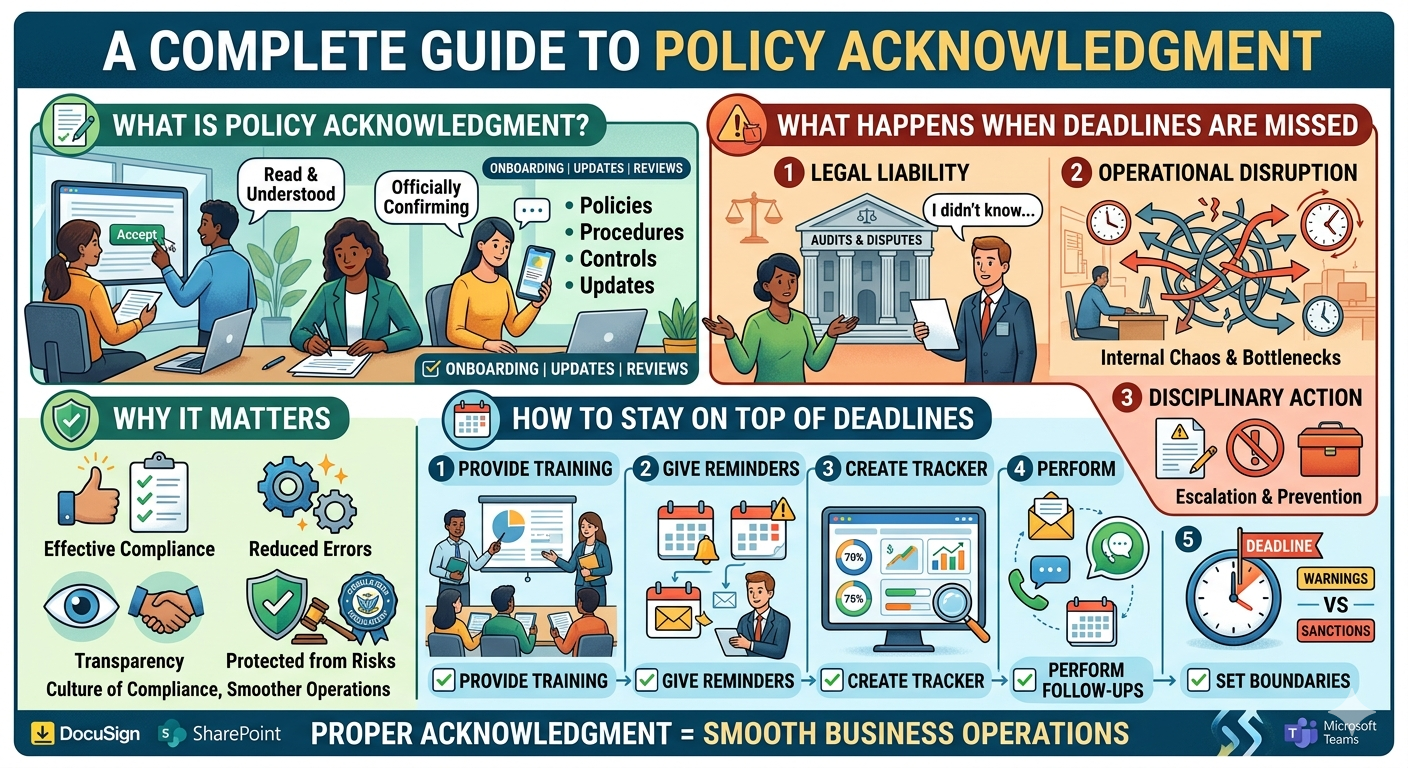
Policy acknowledgment — or policy attestation — refers to the process of employees formally confirming that they have read and understood a document produced by the company. This may include policies, procedures, controls, updates, and other forms of internal regulation. This can be done at any given time, but is most often needed during employee onboarding, quarterly or annual reviews, and any time that company policies are updated.
Employee acknowledgment serves as proof that they have read and accepted the policies and their impact on their roles or departments. It also presents the need for adherence to policy or policy compliance.
This acknowledgment protects the company from risks caused by employee negligence or ignorance, while requiring employers to keep employees updated on all relevant policies, old and new.
In short, it ensures proper policy management at all times, not just when the quarterly or yearly reviews come around.
Tired of reminding staff to read your company policies?
DocRead makes compliance simple
Forms of Policy Acknowledgment
While this may vary from company to company, here are some common ways to track employee policy acknowledgment:
- Written / Physical: Employees sign a hard copy or form confirming they have read and understood the policies.
- Digital / Electronic: Employees send digital confirmation that they have read and understood the policies by replying to an email, completing an online form, or using other portal-based acknowledgment methods.
- System-Tracked: Employees confirm via company systems such as Learning Management Systems, in-app pop-ups, push notifications, or click-through agreements.
Some applications used for policy acknowledgment are DocuSign, Microsoft Teams, MicrosoftForms, SharePoint, and JotForm.
While some companies rely on verbal or implied acknowledgment, formal confirmation is crucial. A simple “yes” in a meeting is no longer sufficient.
Even though it may seem simple, acknowledgment is one of the essential cogs that keeps the company running smoothly.
Why Policy Acknowledgment Matters
Tracking acknowledgment ensures that everyone in the company knows what to do, who is responsible, and when tasks should be completed. Proper acknowledgment:
- Demonstrates effective policy compliance and policy management.
- Reduces errors and miscommunication.
- Fosters transparency and accountability.
- Protects the company from operational, legal, and regulatory risks
Essentially, acknowledgment creates a culture where everyone understands and follows the rules, contributing to smoother operations and shared responsibility.
What Happens When Deadlines Aren’t Met
Failing to meet policy acknowledgment deadlines — or ignoring them altogether — can lead to massive repercussions for the company in the long run:
- Legal Liability
Acknowledgment is more than ticking a box. It protects the company during audits, regulatory compliance checks, and legal disputes.
Without it, employees can claim they were unaware of policies, making the company liable for accidents, data breaches, or safety violations.
Formal acknowledgment provides physical evidence of responsibility.
- Employee Ignorance and Negligence
Without policy acknowledgment, employees may feign ignorance when discussing office rules, regulations, and policies.
For example, if a security officer neglects the proper rotation process for checking CCTV cameras, they might miss a crime or emergency during their shift. Without a Policy Acknowledgment in place, they can simply claim they were unaware this was part of their duties.
This will mean nothing if any negative occurrences have already happened on his watch. For protection against ignorance and negligence, policy acknowledgment is crucial.
- Operational Disruption
Ignoring acknowledgment can lead to internal chaos. Employees unaware of policies may make inconsistent decisions, bypass procedures, or miscommunicate across departments.
Even if 90% of employees comply, the remaining 10% can create bottlenecks that slow down overall operations.
Missing a single policy update or overlooked procedure can ripple across multiple teams, affecting deadlines and productivity.
- Delays in Im Policiesplementing
A lack of policy compliance and understanding can delay not only project approvals and team decisions, but also the implementation of the policies themselves.
For example, if employees fail to review a memo about a new vendor approval policy, the entire process can stall, halting other teams’ work and potentially disrupting operations. In other cases, this could lead to equipment damage, inconsistent customer handling, or other operational issues.
When employees are informed and up-to-date, employers can integrate new policies smoothly into daily processes from conceptualization to announcement to implementation.
- Disciplinary Action and Escalation
Employees represent your company, and their actions reflect on you as a leader. Neglect of policies can lead to shortcomings that harm both operations and reputation.
In some cases, violations may require disciplinary action or escalation, such as suspension, termination, or, in extreme cases, legal investigation. These measures consume time and resources.
Maintaining records of employee acknowledgments allows you to address potential problems proactively, effectively preventing issues before they arise.
Are your policies read on time and by the right people?
DocRead makes compliance simple
How to Stay on Top of Deadlines
Ensuring that you do not miss any policy acknowledgment deadlines is simple: you just need to get ahead. From onboarding employees to updating policies, avoid missing any deadlines by guiding employees through every step of the process.
- Provide a Training Program and Handbook to Employee
Employees should undergo mandatory training to fully understand all of the company’s rules and regulations. Each employee should also be given a handbook that provides a list of all policies they may need to know in accordance with their duties to the company.
Both the Training Program and Employee Handbook should be updated in accordance with the company’s current policies and regulations. Attendance at the training program, as well as receipt of the handbook, should be documented through a signed acknowledgment.
- Regularly Give Out Reminders on Policy Releases
Do not just inform employees about policies on the day they are released — give them time to adjust to the changes.
For example, let them know in advance that you will be making changes to current policies so they can prepare to receive and acknowledge any memos regarding these updates.
- Create a Tracker to View Individual Progress
After announcing any policies, rules, regulations, or updates, request acknowledgment receipts from all employees who received the announcement.
To track who has and has not acknowledged the memo, create a tracker or use a tracking app to monitor each employee’s acknowledgment status. This provides an easy way to see who has submitted their acknowledgment forms and who needs follow-up.
- Perform Follow-Ups as The Deadline Approaches
Set a firm deadline for all employees to emphasize the importance of reading and acknowledging memos and policies. Use your tracker to send follow-up messages to employees who have not yet submitted their acknowledgment receipts. If your policies live in SharePoint Online, policy acknowledgment software for Microsoft 365 such as DocRead can set the deadline, send the follow-ups and record each receipt for you.
Follow-ups can be done through email, online or face-to-face meetings, or private messages via any company-approved messaging application. For example, if the acknowledgment deadline is two weeks, at least three check-ins should be made to check progress or understand reasons for delays.
- Set Boundaries (and Penalties, if Needed)
If necessary, enforce adherence to the acknowledgment deadline.
Employees who exceed the deadline may be subject to disciplinary action. The level of action should depend on whether it is a repeat offense. For first-time offenders, a warning or minor sanction may suffice.
Employees who repeatedly ignore company policies and policy acknowledgment may face more serious actions such as suspension, probation, or termination, as repeated noncompliance demonstrates a lack of regard for the company’s operations.
Policy acknowledgment is an essential part of maintaining control, consistency, and compliance within your company. Proper management of this process will help company operations run more smoothly in the long term.
Remember: the problem is not in the policies themselves, but in the fact that no one is reading them. Make that change today.
Policy Acknowledgment FAQs
Here are some common questions your employees might ask when presented with a new policy, and how you can answer them:
What do I do if I do not understand the policy, or parts of it? And what if I do not agree with any policy changes being made?
Any questions you may have can be directed to your manager, the officer in charge of the policy, or a representative from your HR department. Any concerns or feedback about policy changes may also be raised even after signing the acknowledgment form, as this form simply signifies that you have received and read the information contained in the policy.
What if I fail to acknowledge or follow this policy after signing the acknowledgment form?
Failure to acknowledge or adhere to policies after submitting the acknowledgment form may result in disciplinary action and could be considered in performance or compliance evaluations. The acknowledgment form serves as proof that you are aware of your responsibilities as an employee and of the need to comply with them at all times while working.
Is the signing of any acknowledgment forms legally binding?
While the acknowledgment form is not, in itself, a contract, it serves as a form of documentation that confirms you have read, understood, and received the policy.
Can I ask for a copy of the form that I signed?
Yes. Depending on your company, you may automatically receive a copy of your acknowledgment form, or you may need to request it from the department or point person responsible for handling it.
Get your free Standard Operating Procedures guide
Creating Standard Operating Procedures for your organisation doesn't have to be complicated. This guide will introduce you to the whole lifecycle from creation to training and distribution.
You may also like:
October 16, 2026
October 9, 2026
The Equifax Catastrophe: How One Missed Update Became a $700M Fine In most workplaces, ...
October 2, 2026
The Equifax Catastrophe: How One Missed Update Became a $700M Fine In most workplaces, ...
September 18, 2026
How to Manage Policy Exceptions in Microsoft 365 Without Losing Audit ControlPolicies are designed ...
September 11, 2026
Contractor Policy Acknowledgment: How to Track Compliance for Third PartiesOrganizations often rely on contractors, ...
August 28, 2026
How Do You Migrate Legacy Policies into a Policy Management System?For a lot of ...