
The Difference Between Governance Infrastructure and Governance Theater Most organizations don’t lack governance. They ...
The $2.5 Billion Text: An Autopsy of Wall Street's WhatsApp Meltdown
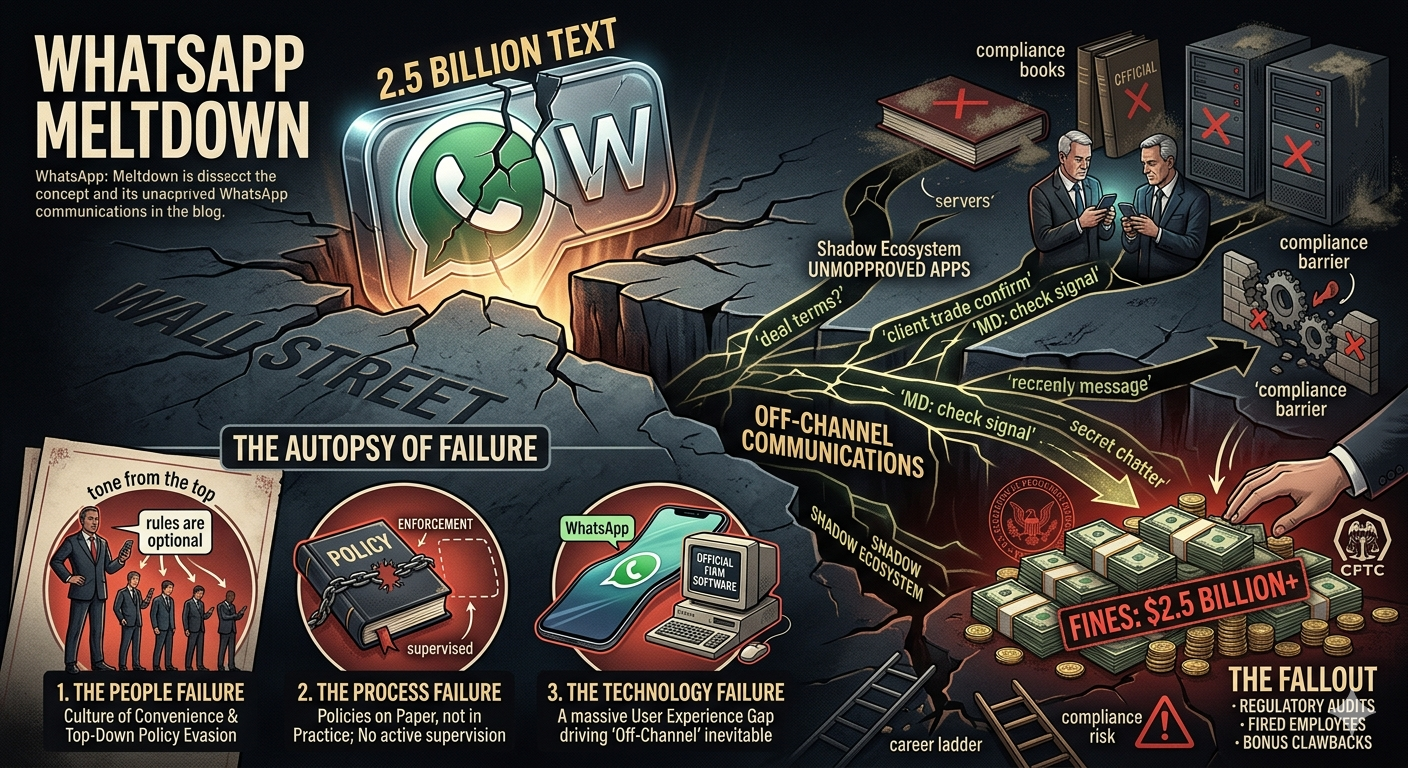
The TL;DR / Executive Summary
- The Companies: JPMorgan, Morgan Stanley, Goldman Sachs, and over a dozen other Wall Street titans.
- The Penalty: A staggering $2.5 Billion+ in combined fines from the SEC and CFTC.
- The Rule Violated: SEC Rule 17a-4 ("Books and Records"), mandating the preservation of business-related electronic communications.
- The Core Failure: A systemic cultural breakdown where employees, including senior leaders, used personal messaging apps for official business, creating a massive, unmonitored black hole of risk.
Tired of reminding staff to read your company policies?
DocRead makes compliance simple
The Context & The Incident
For years, the real rhythm of Wall Street ran on WhatsApp. A trader needed to confirm a position instantly. An investment banker needed a client's quick approval. The firm's official, archived messaging systems felt slow, clunky, and out of touch with the speed of modern business.
So, they took the conversation "off-channel."
This shadow ecosystem operated smoothly from roughly 2018 to 2021. Then, regulators began noticing a pattern. During routine examinations and investigations, they’d ask for communications related to a specific deal, only to be met with official records that were suspiciously empty. Emails and messages they knew must exist were nowhere to be found on company servers.
This triggered a sweeping regulatory probe by the Securities and Exchange Commission (SEC) and the Commodity Futures Trading Commission (CFTC). What they found was a compliance catastrophe. Investigators uncovered thousands of business-critical messages on personal devices, discussing everything from deal terms and client trades to confidential market chatter.
Crucially, senior leaders were among the worst offenders. They not only used these unapproved channels but, by doing so, created and perpetuated a culture where bypassing compliance was the accepted path of least resistance.
The Root Cause Breakdown
Don't blame WhatsApp. The app was just the symptom; the disease was a catastrophic internal failure of governance. When we place this breakdown on the autopsy table, we find clear evidence of failure in three distinct areas.
- The People Failure:
A Culture of Convenience The core issue was a culture that valued speed and deal-making above all else, including regulatory obligations. This wasn't a case of a few rogue junior analysts; it was a systemic problem driven from the top down. When Managing Directors and senior partners routinely use Signal or WhatsApp to close deals, they send a clear, unspoken message to the entire organization: the rules are optional if they get in the way of revenue. This "tone from the top" effectively gave thousands of employees permission to ignore policy, creating a shadow communications network that compliance teams were completely blind to. - The Process Failure:
Policy on Paper, Not in Practice Every single one of these banks had a written policy forbidding the use of personal devices for business communications. The problem? The policies were unenforced and unenforceable. Compliance programs relied on annual attestations and passive training modules instead of active supervision and meaningful consequences. There was no proactive auditing, no random device checks, and no clear link between non-compliance and compensation. A rule that isn't enforced is merely a suggestion. The process failure was treating the existence of a policy as a substitute for the hard work of active, visible enforcement. - The Technology Failure:
A User Experience Gap Compliance lost this battle before it even began because the official, approved technology was awful to use. In a world of seamless, instant consumer apps, employees were handed clunky, slow, and unintuitive corporate software. This massive user experience gap created a vacuum that WhatsApp and Signal were perfectly designed to fill. The firms failed to provide tools that matched the way their people actually worked. By forcing employees to choose between being efficient and being compliant, they made "off-channel" an inevitability.
The Fallout & Liability
The bill for this systemic failure was astronomical. Beginning with JPMorgan’s initial USD 200 million settlement in 2021, the SEC and CFTC swept through the industry, ultimately fining over a dozen firms a combined 2.5 billion.
The violations were so blatant and widespread that one source described the regulators' work as:
"like shooting fish in a barrel."
Beyond the historic fines, the consequences were severe. Firms were forced to hire expensive external compliance consultants to monitor their communications. Employees were fired, and in some cases, bonuses were clawed back.
For the CCOs and risk managers reading this, the message is even more stark: this is a career-defining risk. Regulators are increasingly focused on holding individuals accountable. When a firm cannot produce required records, the assumption is no longer simple negligence; it's a fundamental failure of the entire compliance function.
Are your policies read on time and by the right people?
DocRead makes compliance simple
The "Take It to Work" Checklist
Is your firm vulnerable to the same fate? Don't assume your policy is working. Use this checklist to find your blind spots before a regulator does.
- Conduct a "Shadow IT" Amnesty Survey. Stop sending threatening policy reminders. Instead, run a short, anonymous survey asking what communication tools employees actually use to get their jobs done, both internally and with clients. You can't fix a problem you refuse to see. The answers will likely terrify you, but ignorance is not a defense.
- Make the Right Way the Easy Way. Your biggest vulnerability is a terrible user experience. Partner with IT and your business lines to find and deploy a modern, compliant communication solution that is just as fast and easy to use as WhatsApp. If the compliant path is also the path of least resistance, 90% of your problem disappears overnight.
- Link Compliance Directly to Compensation. Your training PowerPoints are meaningless without teeth. Implement a "zero-tolerance" policy that is visibly enforced from the top down. More importantly, build adherence to communications policies directly into performance reviews and make it a condition for bonus eligibility. When millions in compensation are on the line, behavior changes instantly.
- Run a "Disappearing Records" Drill. Don't wait for a subpoena. Go to your eDiscovery or IT team today with a simple request: "Please pull all communications between high-risk employee X and client Y from three months ago." If they can only produce a handful of formal emails when you know the deal was active, you have found your blind spot. That gap is where your next fine is hiding.

Get your free Standard Operating Procedures guide
Creating Standard Operating Procedures for your organisation doesn't have to be complicated. This guide will introduce you to the whole lifecycle from creation to training and distribution.
You may also like:
September 18, 2026
September 11, 2026
The Difference Between Governance Infrastructure and Governance Theater Most organizations don’t lack governance. They ...
August 28, 2026
The Difference Between Governance Infrastructure and Governance Theater Most organizations don’t lack governance. They ...
August 28, 2026
The Difference Between Governance Infrastructure and Governance Theater Most organizations don’t lack governance. They ...
July 10, 2026
The Difference Between Governance Infrastructure and Governance Theater Most organizations don’t lack governance. They ...
July 3, 2026
The $200 Million WhatsApp Compliance Mistake — and Why It Still Matters in 2026 ...