
The Equifax Catastrophe: How One Missed Update Became a $700M Fine In most workplaces, ...
How to Manage Policy Exceptions in Microsoft 365 Without Losing Audit Control
Policies are designed to establish consistent expectations across an organization. But in practice, there will always be situations where an employee, department, or business unit needs to operate differently from the standard policy.
These exceptions can be legitimate. A particular role may require a different process, a temporary business requirement may make the standard procedure impractical, or a regulatory obligation may justify an alternative approach.
The challenge is not necessarily allowing exceptions. The real challenge is managing them without losing visibility, accountability, or audit control.
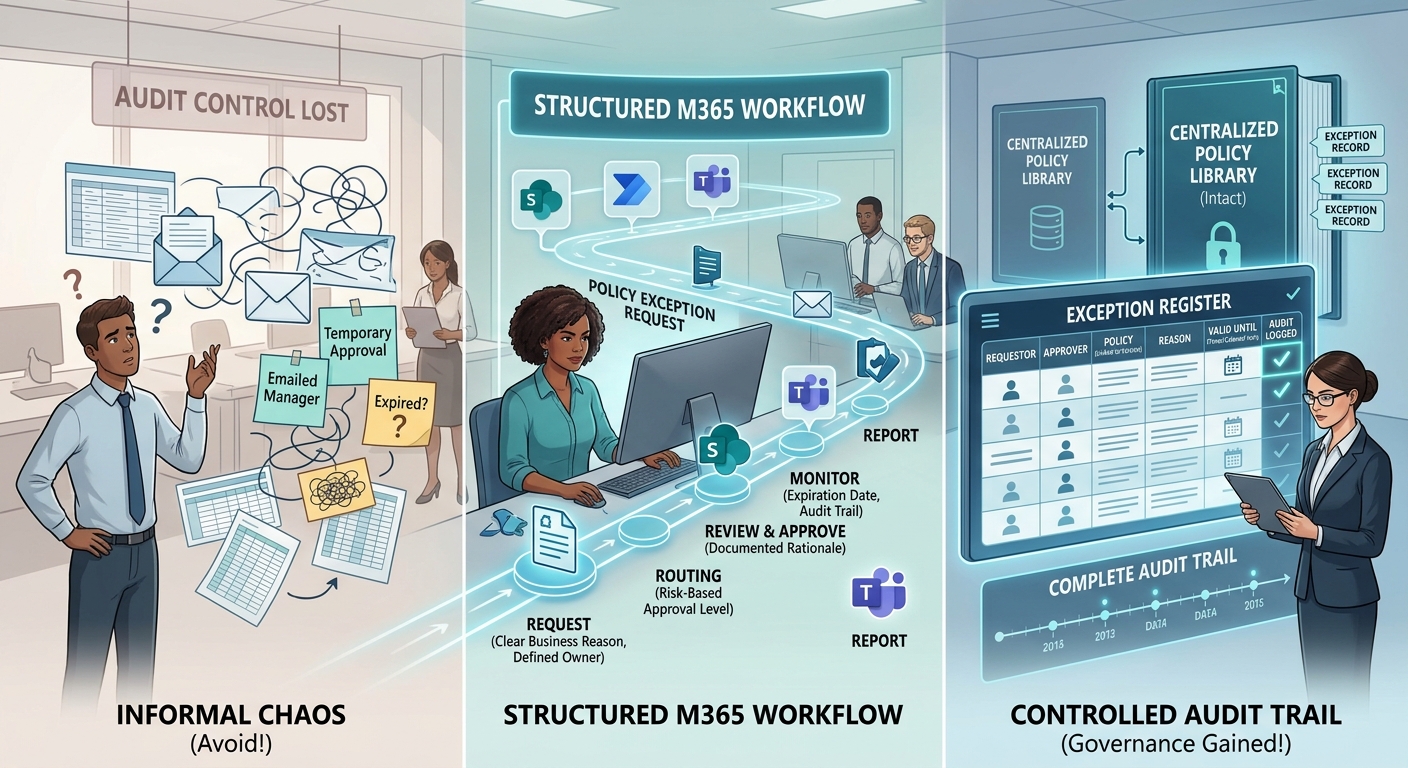
When exceptions are handled through emails, spreadsheets, or informal approvals, organizations can quickly lose track of who received an exception, why it was granted, who approved it, and when it should expire.
A structured policy exception workflow helps organizations address these gaps by establishing a consistent process for requesting, reviewing, approving, documenting, and monitoring exceptions.
Not Every Policy Exception Is a Problem
A policy exception does not automatically indicate poor governance.
In many organizations, exceptions are necessary because policies cannot anticipate every operational scenario. The important distinction is between a controlled exception and an undocumented deviation from policy.
A controlled exception should have a clear business reason, an identified owner, appropriate approval, and a defined period of validity.
Without these controls, temporary exceptions can gradually become permanent practices that no longer receive proper oversight.
Informal Approvals Create Governance Gaps
One of the most common challenges is managing exceptions through email.
An employee may request an exception from their manager, receive approval, and then proceed with the alternative process. Months later, the organization may have difficulty finding the original approval or determining whether the exception is still valid.
Important information can become scattered across inboxes, Teams conversations, spreadsheets, and document folders.
With a proper exception approval workflow, you get a more consistent way to route requests to the appropriate people and document the decision. Instead of relying on individual inboxes, organizations can establish a repeatable process for reviewing and approving policy deviations.
Every Exception Needs a Clear Reason
Allowing an exception without documenting the rationale behind it can create problems during an audit.
Organizations should be able to answer basic questions such as:
- Why was the exception required?
- Who requested it?
- Who approved it?
- Which policy does it relate to?
- What alternative process applies?
- How long is the exception valid?
Documenting this information creates context around the decision and helps distinguish legitimate exceptions from unauthorized deviations.
It also forms the foundation of a policy exception register, giving policy owners a centralized record of active and historical exceptions.
Approval Should Match the Level of Risk
Not every policy exception carries the same level of risk.
An exception involving an administrative process may require only a manager's approval, while an exception relating to information security, financial controls, regulatory requirements, or data protection may require review from a designated compliance or risk owner.
READ: How to Build a Policy Management System in SharePoint
Having an organized exception process allows organizations to establish appropriate approval levels based on the policy and the potential impact of the exception.
This prevents both under-approval and unnecessary bureaucracy while creating a consistent policy waiver process for situations where standard requirements cannot reasonably be followed.
Exceptions Should Have an Expiration Date
One of the biggest risks with policy exceptions is that temporary arrangements can become permanent without anyone noticing.
For example, an employee may receive a three-month exception to follow an alternative procedure. If there is no reminder or review process, that exception could continue indefinitely.
Every exception should therefore have a defined validity period wherever appropriate.
Automated reminders can help policy owners review approaching expiration dates and determine whether an exception should be renewed, modified, or closed.
This is particularly valuable for compliance exception tracking, where organizations may need to demonstrate that exceptions were actively monitored rather than simply approved and forgotten.
Keep the Original Policy Intact
Granting an exception should not normally mean changing the underlying policy every time an individual situation arises.
The policy should remain the authoritative source of the organization's standard requirements, while the exception record documents the approved deviation.
This distinction is important for auditability. It allows organizations to demonstrate both what the standard policy required and why a particular individual or group was permitted to follow a different process.
Maintaining this separation also makes governance exception management easier, as policy owners can review exceptions without creating multiple unofficial versions of the underlying policy.
Maintain a Complete Audit Trail
Audit control depends on being able to reconstruct what happened.
For policy exceptions, this may include the original request, approval, supporting documentation, applicable policy version, effective date, expiration date, and any subsequent review or renewal.
A complete audit trail for policy exceptions gives organizations evidence that exceptions were not simply granted informally.
It also helps auditors and compliance teams understand whether exceptions are isolated events or part of a wider pattern that may require changes to the underlying policy.
Don't Lose Track of Policy Versions
Policy exceptions can become particularly difficult to manage when the underlying policy changes.
Suppose an employee was granted an exception against version 3 of a policy. The organization later publishes version 4, changing the requirements that originally led to the exception.
If the exception record does not identify the relevant policy version, it may be unclear whether the exception still applies.
Linking exceptions to specific policy versions helps organizations determine whether existing exceptions need to be reviewed when policies are updated.
Use Microsoft 365 as the Foundation
Microsoft 365 already provides many of the tools organizations can use to establish stronger exception governance.
SharePoint can provide a central location for policies and supporting documentation. Microsoft Entra ID can help identify users and groups. Power Automate can automate notifications, approvals, and reminders, while Microsoft Teams can support communication between stakeholders.
However, connecting these tools into a consistent policy exception process can require significant configuration and ongoing administration.
The objective should not simply be to create another approval workflow. Organizations need a process that connects exceptions with the policies, employees, approvals, and audit evidence they relate to.
Avoid Managing Exceptions in Spreadsheets
Spreadsheets can appear to be a convenient solution for tracking exceptions.
A typical spreadsheet might include the employee's name, policy, approval date, expiry date, and approver. But as the number of exceptions grows, maintaining the spreadsheet becomes increasingly difficult.
There is also a risk that records become outdated, duplicated, or disconnected from the actual policy documents and approval evidence.
A centralized approach reduces reliance on manually maintained registers and provides a more reliable source of information.
How DocRead Can Support Policy Governance
DocRead is designed specifically for SharePoint and Microsoft 365, allowing organizations to manage policies within their existing Microsoft environment.
While policy exceptions may require organization-specific approval workflows, DocRead can provide the surrounding policy governance capabilities needed to keep the process controlled.
Policies can remain within SharePoint while organizations use features such as targeted policy distribution, employee acknowledgements, compliance monitoring, automated reminders, and reporting.
This helps create a clearer relationship between the policy itself and the evidence showing that employees have received and acknowledged it.
For organizations managing exceptions alongside their wider policy library, this can help reduce reliance on disconnected spreadsheets, email trails, and manual tracking.
Turning Exceptions Into Useful Governance Data
Policy exceptions should not only be viewed as individual administrative cases.
Over time, exception records can reveal patterns.
If employees repeatedly request exceptions to the same requirement, the underlying policy may be unrealistic, outdated, or poorly communicated.
Regularly reviewing exception data can therefore help policy owners identify areas where policies need to be clarified, updated, or redesigned.
In this way, exception management becomes part of the policy lifecycle rather than simply an administrative task.
Strengthening Policy Exception Management
Allowing exceptions does not have to weaken policy governance.
The key is ensuring every exception is documented, appropriately approved, connected to the relevant policy, reviewed regularly, and supported by a clear audit trail.
Microsoft 365 provides a strong foundation for achieving this through SharePoint, Microsoft Entra ID, Power Automate, and other existing capabilities. However, organizations also need processes that connect these tools into a consistent policy management framework.
By extending SharePoint with dedicated policy management capabilities such as DocRead, organizations can strengthen policy distribution, acknowledgement tracking, compliance monitoring, and reporting without moving their policies into an entirely separate repository.
The goal is not to eliminate policy exceptions. It is to make sure that when exceptions are necessary, the organization can explain what was allowed, why it was allowed, who approved it, how long it applied, and what happened afterward.
That is what turns a policy exception from a governance gap into a controlled and auditable business process.
Tired of reminding staff to read your company policies?
DocRead makes compliance simple
Are your policies read on time and by the right people?
DocRead makes compliance simple
Get your free Standard Operating Procedures guide
Creating Standard Operating Procedures for your organisation doesn't have to be complicated. This guide will introduce you to the whole lifecycle from creation to training and distribution.
You may also like:
October 2, 2026
September 18, 2026
How to Manage Policy Exceptions in Microsoft 365 Without Losing Audit ControlPolicies are designed ...
September 11, 2026
Contractor Policy Acknowledgment: How to Track Compliance for Third PartiesOrganizations often rely on contractors, ...
August 28, 2026
How Do You Migrate Legacy Policies into a Policy Management System?For a lot of ...
August 28, 2026
What Features Should You Look for in Policy Management Software for SharePoint?Choosing policy management ...
July 10, 2026
How Long Does It Take to Implement Policy Management Software in Microsoft 365?When organizations ...