
The Difference Between Governance Infrastructure and Governance Theater Most organizations don’t lack governance. They ...
How to Prove Policy Compliance Without Chasing Employees for Acknowledgment
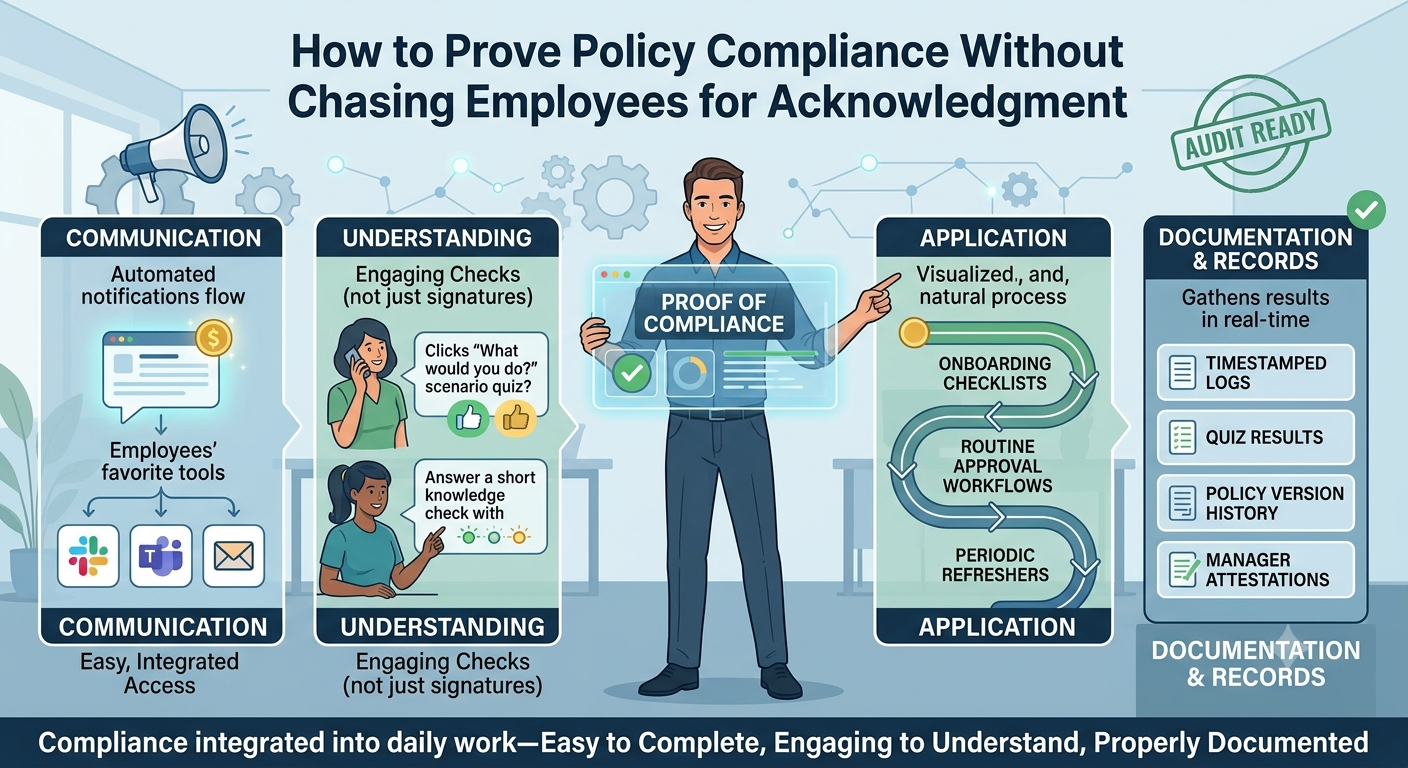
Policy compliance ensures that employees understand and follow the rules, standards, and regulations that guide your organization—whether they’re internal policies or external legal requirements.
At its core, it’s not just about sending out documents. It’s about being able to prove that policies were communicated, understood, and applied in day-to-day work—not just when an audit comes around.
And that part matters more than most people think.
Without clear proof of compliance, organizations open themselves up to risk—whether that’s failed audits, inconsistent enforcement, or situations where employees claim they were never properly informed. When something goes wrong, “we sent it out” isn’t enough. You need to show that it was received, understood, and applied.
Acknowledgment is only one part of compliance
Acknowledgment can take many forms:
- Signed documents (physical or digital)
- Email acknowledgments or replies
- Messages in group chats or direct messages
- One-click acknowledgment buttons
- Training completion records
- Quiz or assessment results
- Recorded acknowledgments (video or calls)
But here’s the reality: getting employees to consistently acknowledge policies can be harder than it sounds.
And no one wants to be the manager who keeps asking, “Hey, have you reviewed that policy yet?”
So how do you prove compliance without becoming the “nagging boss”?
The answer is simple: make compliance easy, engaging, and built into how work already happens.
Tired of reminding staff to read your company policies?
DocRead makes compliance simple
Provide incentives.
Routine tasks like policy acknowledgment rarely excite anyone. Light, thoughtful incentives can improve participation without forcing it.
Think:
- Team-based milestones
- Small rewards or recognition for timely completion
- Simple perks for full participation (like team appreciation moments or flexible break benefits, where appropriate)
The goal isn’t to “bribe” employees, but rather to reinforce timely action and create a positive culture around compliance.
Just make sure participation is still properly tracked and documented. Incentives should support compliance, not replace proof of it.
Some organizations also connect completion rates to broader team performance indicators, not as a standalone metric, but as part of overall operational discipline.
Ask questions.
A common issue with acknowledgments is that they become mechanical—similar to clicking “I agree” without real engagement.
Instead, introduce small moments of interaction:
- Short scenario-based questions
- Quick knowledge checks
- Polls during team discussions or training
- Simple “what would you do?” situations
This shifts the focus from “Did they click?” to “Did they understand?”
For example, instead of simply confirming a data privacy policy, you might ask: “What would you do if you received a suspicious email containing client data?”
These responses can also be recorded, giving you evidence of engagement and comprehension.
Make it easy.
If acknowledgment feels like a chore, it will be treated like one.
The most effective systems reduce friction as much as possible:
One-click acknowledgments
Mobile-friendly access
QR codes for quick confirmation
Short summaries paired with full policy documents
Embedded workflows inside existing tools (like Slack, Microsoft Teams, or HR systems such as Workday)
Some organizations also integrate acknowledgment into onboarding checklists or routine approval workflows so it becomes part of normal work instead of just another extra task.
The easier it is, the more likely it is to get done, and the cleaner your compliance records will be.
Are your policies read on time and by the right people?
DocRead makes compliance simple
Common mistakes
Even with good intentions, a few missteps can undermine your compliance efforts:
Treating acknowledgment as a one-time activity.
Many organizations treat policy acknowledgment as a single task completed during rollout. In reality, policies evolve, and employees forget over time, so compliance needs periodic reinforcement to stay valid and relevant.
Relying on signatures without verifying understanding.
A signed document or a click-only option proves only that an employee received the policy, not that they understood it. Without any follow-up or engagement, it becomes difficult to defend comprehension when issues arise.
Overcomplicating the process, leading to low completion rates.
If acknowledgment requires too many steps or unclear instructions, employees are more likely to delay or rush through it. Simple, clear processes consistently lead to higher completion and better-quality compliance data.
Doing enforcement inconsistently.
When policies are enforced differently across teams, compliance loses credibility. Consistency is key to showing that rules are real, active, and applied fairly across the organization.
Too much manual chasing.
Relying on reminders and follow-ups to collect acknowledgments is not scalable. It also increases friction between teams and often leads to incomplete or delayed compliance.
Common mistakes
Even with good intentions, a few missteps can undermine your compliance efforts:
Treating acknowledgment as a one-time activity.
Many organizations treat policy acknowledgment as a single task completed during rollout. In reality, policies evolve, and employees forget over time, so compliance needs periodic reinforcement to stay valid and relevant.
Relying on signatures without verifying understanding.
A signed document or a click-only option proves only that an employee received the policy, not that they understood it. Without any follow-up or engagement, it becomes difficult to defend comprehension when issues arise.
Overcomplicating the process, leading to low completion rates.
If acknowledgment requires too many steps or unclear instructions, employees are more likely to delay or rush through it. Simple, clear processes consistently lead to higher completion and better-quality compliance data.
Doing enforcement inconsistently.
When policies are enforced differently across teams, compliance loses credibility. Consistency is key to showing that rules are real, active, and applied fairly across the organization.
Too much manual chasing.
Relying on reminders and follow-ups to collect acknowledgments is not scalable. It also increases friction between teams and often leads to incomplete or delayed compliance.
What actually proves compliance?
Here’s the key point many organizations miss: acknowledgment alone does not equal compliance.
Employees are expected to follow policies whether they sign them or not. What matters is your ability to demonstrate three things:
Communication: The policy was clearly shared and accessible
Understanding: Employees engaged with and understood it
Application: The policy is actually followed in practice
This is where supporting evidence becomes critical:
Training records
System and activity logs
Manager attestations
Periodic audits or reviews
Make compliance defensible, not just visible
To strengthen your compliance structure:
Keep timestamped records of acknowledgments and training completion
Tie records to specific policy versions
Store everything in a centralized, retrievable system
Ensure consistent enforcement across teams
Managers also play an important role by reinforcing expectations, guiding discussions, and confirming adherence within their teams.
Remember: you don’t need to chase employees to prove policy compliance, you need a system that makes compliance easy to complete, engaging enough to understand, and properly documented.
When those three things are in place, compliance stops being a follow-up exercise and becomes part of how the organization naturally operates.
Because at the end of the day, compliance isn’t about who clicked “acknowledge”. It’s about how well you can prove it when it actually counts.

Get your free Standard Operating Procedures guide
Creating Standard Operating Procedures for your organisation doesn't have to be complicated. This guide will introduce you to the whole lifecycle from creation to training and distribution.
You may also like:
September 11, 2026
August 28, 2026
The Difference Between Governance Infrastructure and Governance Theater Most organizations don’t lack governance. They ...
August 28, 2026
The Difference Between Governance Infrastructure and Governance Theater Most organizations don’t lack governance. They ...
July 10, 2026
The Difference Between Governance Infrastructure and Governance Theater Most organizations don’t lack governance. They ...
July 3, 2026
The Difference Between Governance Infrastructure and Governance Theater Most organizations don’t lack governance. They ...
June 19, 2026
The Difference Between Governance Infrastructure and Governance Theater Most organizations don’t lack governance. They ...