
The Difference Between Governance Infrastructure and Governance Theater Most organizations don’t lack governance. They ...
What’s the Biggest Compliance Risk in SharePoint That Most Teams Overlook?
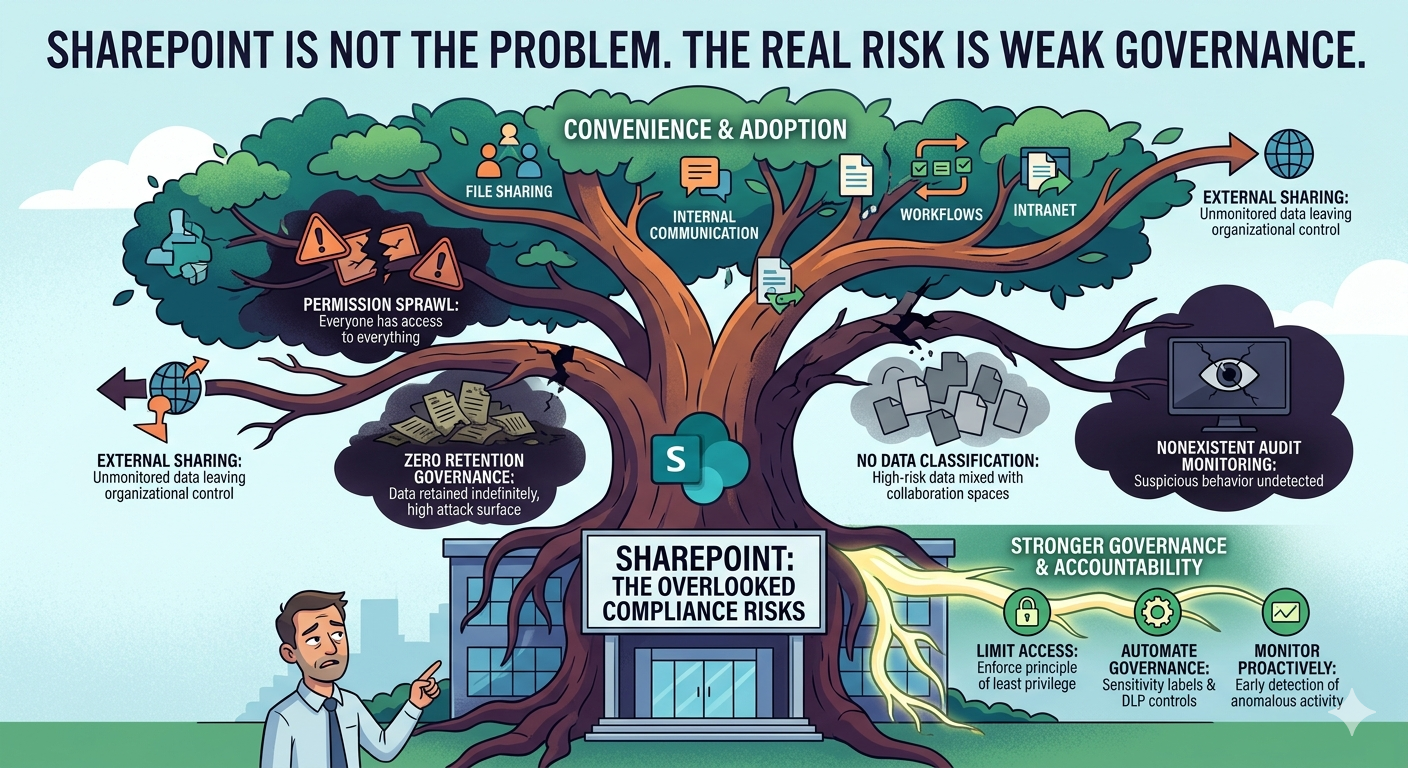
For many organizations, Microsoft SharePoint is the backbone of daily operations.
Since its launch in 2001, SharePoint has evolved into far more than a document repository. It powers collaboration, file sharing, internal communication, workflow management, and corporate intranets across businesses of every size.
Its convenience is exactly why it’s so widely adopted.
But that same convenience can quietly create serious compliance and security risks when governance falls behind usage.
Most organizations don’t experience SharePoint-related compliance issues because the platform itself is insecure. Problems usually arise because SharePoint is treated as “just storage” instead of a critical business system that requires ongoing oversight, access management, and data governance.
Here are some of the most overlooked SharePoint compliance risks, and what organizations can do to reduce them.
Everyone has access to everything.
One of the most common SharePoint risks is permission sprawl — the gradual expansion of user access across sites, folders, libraries, and files.
What begins as temporary collaboration access often becomes permanent. Over time, organizations lose visibility into:
- Who has access
- Why they have access
- Whether that access is still necessary
- Which users hold elevated privileges
This becomes especially dangerous when SharePoint contains sensitive information such as:
- Employee records
- Financial report
- Legal contracts
- Customer information
- Intellectual property
The risk increases further when permission inheritance is broken at the folder or document level. IT teams may assume access restrictions are in place while hidden, unique permissions continue exposing sensitive content to unintended users.
Tired of reminding staff to read your company policies?
DocRead makes compliance simple
Why it’s a Compliance Risk:
Excessive permissions violate the principle of least privilege, which is a foundational requirement in frameworks such as GDPR, HIPAA, ISO 27001, and SOC 2.
Poor access control can lead to:
- Regulatory penalties
- Failed audits
- Insider threats
- Accidental data exposure
- Unauthorized data access
- Breach notification requirements
There is management for external sharing.
SharePoint makes collaboration easy by allowing users to share files externally through guest access and sharing links.
Unfortunately, it also makes it easy for sensitive data to leave organizational control.
Without proper governance, externally shared files may be:
- Forwarded to unintended recipients
- Shared without approval
- Accessible long after a project or vendor relationship ends
Anonymous “Anyone with the link” sharing is particularly risky because organizations cannot reliably verify who ultimately accessed the content.
Why it’s a Compliance Risk:
Most privacy and security regulations require organizations to maintain strict control over regulated information and demonstrate accountability for data access.
Unmonitored external sharing weakens:
- Data confidentiality
- Access accountability
- Audit traceability
- Vendor risk management
A single exposed file may contain personally identifiable information (PII), financial disclosures, health information, or confidential business data.
The result can include regulatory investigations, contractual violations, financial loss, and reputational damage.
Are your policies read on time and by the right people?
DocRead makes compliance simple
There is zero retention governance.
Retention governance determines how long information should be preserved and when it should be securely deleted.
In SharePoint environments with weak retention controls, organizations typically face two major risks:
- Critical records are deleted or modified too early
- Obsolete sensitive data is retained indefinitely
The first issue can compromise legal, financial, or operational requirements. The second expands the organization’s attack surface by retaining data that no longer serves business value.
Why it’s a Compliance Risk:
Most regulatory frameworks include specific retention and records management requirements.
Poor retention governance can lead to:
- Litigation sanctions
- Audit failures
- Regulatory fines
- Inability to support legal claims
- Increased exposure during data breaches
Over-retention is also a compliance issue because organizations remain responsible for protecting outdated sensitive information they no longer need.
No data is classified.
Most regulatory frameworks include specific retention and records management requirements.
Poor retention governance can lead to:
- Litigation sanctions
- Audit failures
- Regulatory fines
- Inability to support legal claims
- Increased exposure during data breaches
Over-retention is also a compliance issue because organizations remain responsible for protecting outdated sensitive information they no longer need.
Why it’s a Compliance Risk
Many compliance frameworks require organizations to identify, monitor, and protect regulated data.
If sensitive data is not classified properly:
- Encryption policies may not apply
- Data Loss Prevention (DLP) controls may fail
- Retention policies may not trigger correctly
- Monitoring tools may miss critical exposures
In short, organizations cannot effectively protect data they cannot identify.
Audit monitoring is nonexistent.
Many organizations collect SharePoint audit logs but rarely review them proactively.
This creates a dangerous visibility gap where suspicious behavior remains undetected until after damage has already occurred.
Without active monitoring, organizations may miss:
- Unauthorized access attempts
- Suspicious external sharing
- Insider threats
- Data exfiltration activity
- Mass downloads
- Unusual login behavior
Audit logs only provide value when they are actively reviewed, analyzed, and tied to incident response processes.
Why it’s a Compliance Risk:
Most modern security and privacy standards require organizations to:
- Monitor access to sensitive data
- Detect anomalous activity
- Maintain audit trails
- Investigate incidents promptly
Weak monitoring limits both prevention and forensic investigation capabilities.
How to deal with these gaps
The goal is not to eliminate SharePoint usage. Rather, the goal is to govern it properly.
Limit Access and Strengthen Permission Controls
Organizations should enforce the principle of least privilege by ensuring employees only access the information necessary for their role.
This includes:
Conducting regular permission reviews
Removing inactive accounts and former employees
Limiting the number of site owners and administrators
Using role-based access controls
Restricting anonymous sharing links
Regularly reviewing external collaborator access
The fewer unnecessary access points that exist, the lower the risk of accidental exposure and misuse.
Automate Data Governance and Classification
Manual governance processes rarely scale effectively.
Organizations should automate wherever possible by:
Applying sensitivity labels
Enabling automated retention policies
Implementing Data Loss Prevention (DLP) controls
Automatically classifying sensitive information
Separating high-risk data from collaboration spaces
Automation improves consistency, visibility, and compliance enforcement while reducing dependence on user behavior alone.
Monitory Activity Before Incidents Escalate
Strong compliance programs focus on early detection, not just incident response.
Organizations should:
Enable comprehensive audit logging
Review access and sharing activity regularly
Configure alerts for suspicious behavior
Monitor unusual download activity
Integrate SharePoint logs into security monitoring platforms
Proactive monitoring helps organizations identify threats before they become major incidents and demonstrates stronger compliance readiness during audits and regulatory reviews.
Remember: SharePoint itself is not the problem.
The real risk comes from organizations treating it as a simple storage platform instead of a critical business system that handles sensitive data every day.
According to the World Economic Forum, the vast majority of cyber incidents involve some form of human error.
Mistakes will happen. Weak governance makes those mistakes far more costly.
The organizations that reduce compliance risk most effectively are not the ones that avoid collaboration tools — they are the ones that build strong controls, visibility, and accountability around them.
Get your free Standard Operating Procedures guide
Creating Standard Operating Procedures for your organisation doesn't have to be complicated. This guide will introduce you to the whole lifecycle from creation to training and distribution.
You may also like:
September 18, 2026
September 11, 2026
The Difference Between Governance Infrastructure and Governance Theater Most organizations don’t lack governance. They ...
August 28, 2026
The Difference Between Governance Infrastructure and Governance Theater Most organizations don’t lack governance. They ...
August 28, 2026
The Difference Between Governance Infrastructure and Governance Theater Most organizations don’t lack governance. They ...
July 10, 2026
The Difference Between Governance Infrastructure and Governance Theater Most organizations don’t lack governance. They ...
July 3, 2026
The $200 Million WhatsApp Compliance Mistake — and Why It Still Matters in 2026 ...