
Microsoft Purview vs Policy Acknowledgment Software: What Each Tool Does (and Doesn’t) Do Microsoft ...
Policy Management During a Merger or Acquisition: A 90-Day Compliance Plan
When two organizations merge, or one company acquires another, there's a lot to bring together: employees, systems, departments, processes, and company cultures. But one area that can easily get overlooked during the transition is policy management.
Both organizations may have their own employee handbooks, information security policies, health and safety procedures, approval processes, and compliance requirements. Some documents may overlap, others may contradict each other, and certain policies may only apply to specific locations or business units.
Simply moving everything into a shared document library doesn't solve the problem. Organizations need to determine which policies remain relevant, which should be updated, and how employees will be informed of the changes.
A structured post-merger compliance plan can help make this transition more manageable. Here's how organizations can approach policy management during the first 90 days of a merger or acquisition.
Tired of reminding staff to read your company policies?
DocRead makes compliance simple
When two organizations merge, or one company acquires another, there's a lot to bring together: employees, systems, departments, processes, and company cultures. But one area that can easily get overlooked during the transition is policy management.
Both organizations may have their own employee handbooks, information security policies, health and safety procedures, approval processes, and compliance requirements. Some documents may overlap, others may contradict each other, and certain policies may only apply to specific locations or business units.
Simply moving everything into a shared document library doesn't solve the problem. Organizations need to determine which policies remain relevant, which should be updated, and how employees will be informed of the changes.
A structured post-merger compliance plan can help make this transition more manageable. Here's how organizations can approach policy management during the first 90 days of a merger or acquisition.
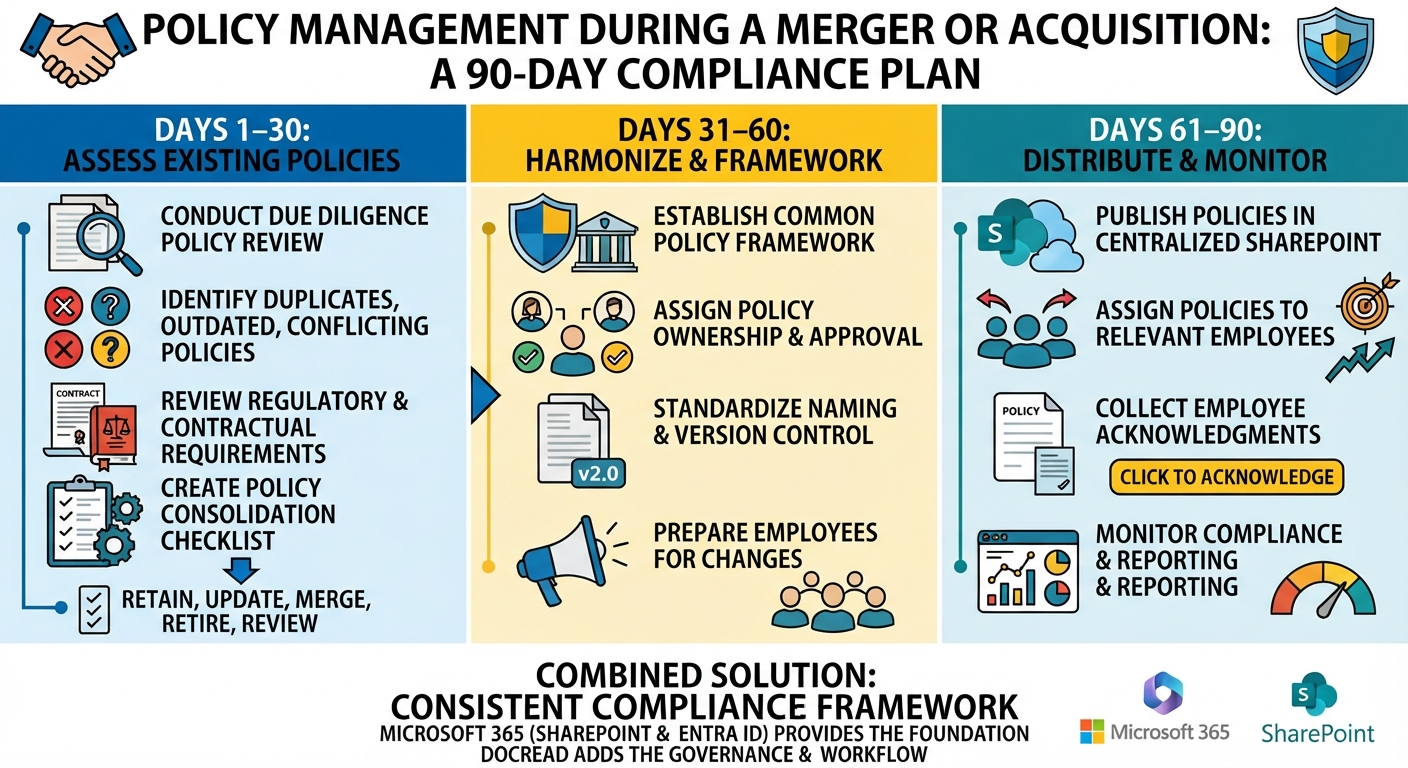
Days 1–30: Assess Existing Policies and Compliance Requirements
The first month should focus on understanding what both organizations already have in place.
Before combining policy libraries, conduct a due diligence policy review to identify existing documents, their owners, approval status, review dates, and any regulatory or contractual requirements attached to them.
Pay particular attention to:
- Information security and data protection policies
- Employee handbooks and codes of conduct
- Health and safety procedures
- Acceptable use and access control policies
- Regulatory and industry-specific requirements
- Business continuity and incident response procedures
- Employee onboarding and offboarding processes
It's also worth identifying duplicate documents, outdated versions, policies that haven't been formally approved, and procedures that are still maintained through email or local storage.
At this stage, don't assume the acquiring company's policies should automatically replace those of the acquired organization. Some existing policies may reflect local regulations, customer commitments, or operational requirements that still need to be maintained.
The goal is to understand the current situation before making changes.
Create a Policy Consolidation Checklist
Once the initial review is complete, categorize the documents based on what needs to happen next.
A practical policy consolidation checklist might include:
- Retain: Policies that remain relevant and compliant.
- Update: Documents that need revisions to reflect the combined organization's requirements.
- Merge: Similar policies that can be consolidated into a single document.
- Retire: Outdated or duplicate policies that are no longer needed.
- Review: Documents requiring legal, compliance, or departmental approval.
Assign an owner to each policy and record its current version, approval status, and intended action.
This creates a clearer picture of the work ahead and helps prevent important documents from disappearing during the transition.
Days 31–60: Harmonize Policies and Establish a Common Framework
With the initial assessment complete, the next step is deciding how policies will work across the combined organization.
This is where merger policy harmonization becomes important.
Two companies may have different approaches to the same requirement. For example, one organization may require employees to change passwords every 90 days, while the other uses a different authentication policy based on modern identity security practices.
Rather than simply choosing one document over the other, organizations should review the underlying requirements, assess the associated risks, and establish a consistent approach that reflects the combined organization's needs.
Some policies may be standardized across the entire business, while others should remain specific to certain regions, departments, or operational environments.
Establish Policy Ownership and Approval
A merger can create uncertainty around who is responsible for maintaining policies.
Department heads may change, compliance teams may be reorganized, and existing policy owners may move into different roles.
Each policy should have a clearly assigned owner, an approval authority, and a defined review schedule.
It's also important to establish a consistent document structure, naming convention, version-control process, and approval workflow.
These decisions provide the foundation for managing policies long after the initial integration is complete.
Prepare Employees for Policy Changes
Policy harmonization isn't just an administrative exercise. Employees need to understand which requirements have changed and what those changes mean for their responsibilities.
This is particularly important when the acquired organization has different workplace procedures, security expectations, or reporting requirements.
Organizations should identify which employee groups need to receive updated policies and whether additional training or acknowledgments are required.
A structured employee policy migration process helps ensure that employees aren't left relying on outdated documents or instructions from their previous organization.
Days 61–90: Distribute Policies and Monitor Compliance
By the third month, organizations should be ready to begin distributing the approved policies across the combined workforce.
This is where a centralized policy management process becomes especially useful.
Instead of sending documents individually through email, policies can be organized in SharePoint and assigned to employees based on department, location, job role, or Microsoft Entra ID group membership.
This is particularly helpful when the organization has inherited different workforce structures or operates across multiple locations.
READ: Contractor Policy Acknowledgement: How to Track Compliance for Third Parties
Collect Employee Acknowledgments
When important policies change, organizations may need employees to confirm that they've received and read the updated requirements.
Simply making a document available in SharePoint doesn't establish whether employees have actually reviewed it.
A structured acknowledgement process helps create records showing which employees received the relevant policy, which version they acknowledged, and when they completed the confirmation.
For critical policies, organizations may also introduce knowledge checks or additional training to verify understanding.
Monitor Outstanding Acknowledgments
Following distribution, administrators need visibility into completion rates.
Identify employees who haven't acknowledged required policies, send reminders, and follow up with managers where necessary.
Centralized reporting helps compliance teams monitor progress across departments and locations without manually combining spreadsheets or searching through email conversations.
It also provides useful evidence when demonstrating that policy changes were communicated during the integration.
Your 90-Day Policy Management Checklist
Here's a simplified overview of what organizations should aim to accomplish during the first three months.
Days 1–30: Assessment
- Inventory policies from both organizations.
- Identify duplicate, outdated, and conflicting documents.
- Review regulatory and contractual requirements.
- Identify policy owners and approval authorities.
- Categorize policies for retention, revision, consolidation, or retirement.
Days 31–60: Harmonization
- Establish a common policy framework.
- Review and update conflicting policies.
- Assign owners and approval responsibilities.
- Standardize document naming and version control.
- Identify employee groups affected by policy changes.
- Prepare updated policies for approval.
Days 61–90: Distribution and Monitoring
- Publish approved policies in a centralized SharePoint location.
- Assign policies to relevant employees.
- Distribute updated documents and request acknowledgments.
- Send reminders for outstanding acknowledgments.
- Monitor compliance through centralized reporting.
- Retain historical records and migration evidence.
The 90-day timeline is a practical starting point rather than a fixed deadline. Larger organizations, complex acquisitions, and heavily regulated industries may need additional time, particularly where legal reviews and operational changes are involved.
How Microsoft 365 Can Support M&A Policy Integration
For organizations already using Microsoft 365, SharePoint provides a convenient foundation for bringing policies together.
Instead of maintaining separate document repositories, organizations can establish centralized policy libraries with consistent metadata, permissions, and version control.
Microsoft Entra ID can help identify employees and assign policies based on group membership, while Power Automate can support approval processes, notifications, and review reminders.
However, M&A compliance integration involves more than consolidating documents. Organizations also need to distribute policies, collect acknowledgments, monitor completion, and maintain evidence of compliance.
Managing all of this manually can become difficult, especially when two organizations bring different processes and hundreds of existing policies into the same environment.
Where DocRead Fits Into the Process
DocRead is designed specifically for SharePoint and Microsoft 365, helping organizations manage policy distribution and employee acknowledgments within their existing Microsoft environment.
During an acquisition, this can be particularly useful once policies have been reviewed, approved, and organized in the new SharePoint environment.
DocRead allows administrators to assign policies to specific employees or groups, request acknowledgments, send automated reminders, and monitor completion through centralized reporting.
This helps simplify acquisition policy management by giving administrators better visibility into how updated policies are communicated across the combined workforce.
Rather than introducing another document repository, policies remain in SharePoint while DocRead adds the governance capabilities needed to manage their distribution and acknowledgment.
Organizations can also use its reporting capabilities to maintain records of employee acknowledgments, supporting the wider compliance and audit process.
Don't Let Policy Integration Become an Afterthought
Mergers and acquisitions involve significant organizational change, and policy management is an important part of making that transition work.
Without a structured approach, employees may continue following outdated procedures, conflicting policies may remain in circulation, and compliance teams may struggle to establish which requirements apply across the combined organization.
A well-planned 90-day approach helps bring order to the process: review existing policies, harmonize requirements, establish ownership, and communicate approved changes to employees.
Microsoft 365 and SharePoint provide the foundation for managing these documents, while dedicated policy management software such as DocRead can help automate distribution, acknowledgments, and compliance monitoring.
Ultimately, successful policy integration isn't just about creating one shared policy library. It's about making sure everyone across the newly combined organization understands which policies apply, where to find them, and what they're expected to do.
That's how organizations can manage change management compliance while building a consistent policy framework for the future.
Are your policies read on time and by the right people?
DocRead makes compliance simple
Get your free Standard Operating Procedures guide
Creating Standard Operating Procedures for your organisation doesn't have to be complicated. This guide will introduce you to the whole lifecycle from creation to training and distribution.
You may also like:
November 20, 2026
November 13, 2026
How to Assign Required Policies with Microsoft Entra ID Dynamic Groups Not every employee ...
November 9, 2026
Published: November 9, 2026 A policy review is a scheduled check that a policy ...
November 9, 2026
Published: November 9, 2026 To write a policy, confirm a policy is needed, name ...
November 9, 2026
A HIPAA compliance audit checks whether a covered entity or business associate meets the ...
November 6, 2026
How Do You Migrate Legacy Policies into a Policy Management System? For a lot ...