
Which Departments Benefit from Policy Management Software in Microsoft 365? Many organizations view policy ...
How to Manage Multilingual Policy Acknowledgments Across Global Teams
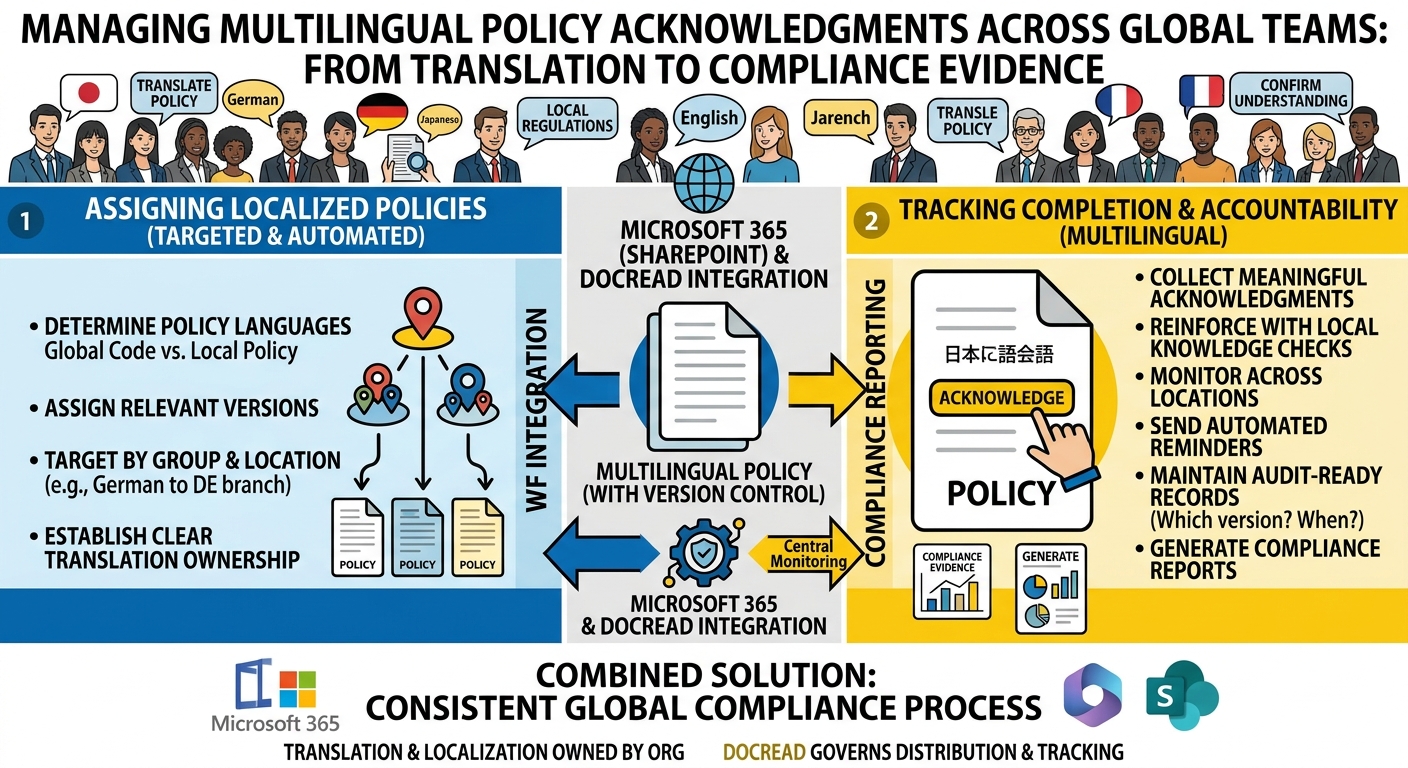
When an organization operates across multiple countries, communicating policies involves more than publishing a document and asking employees to confirm they've read it.
Employees may speak different languages, work across different time zones, and follow different local regulations. A policy written in English might be clear to headquarters but difficult for employees elsewhere to understand fully.
For organizations with a global workforce, the challenge is making policies accessible in the right languages while maintaining consistent standards and reliable evidence of compliance.
Effective multilingual policy management helps bring these requirements together, ensuring employees receive relevant policies and administrators can track acknowledgments across locations.
Translating Policies Is Only the Beginning
Translating a policy doesn't automatically mean it has been communicated effectively.
Consider an organization with offices in the UK, Germany, Japan, and the Philippines. Its global code of conduct may be written in English, but employees in each location might need translated versions to understand the requirements confidently.
The organization must also determine who receives each version, whether translations reflect the latest approved policy, and how acknowledgments are recorded.
Without a coordinated process, outdated translations can circulate, employees may receive conflicting guidance, and compliance teams may struggle to confirm whether everyone has completed the required acknowledgments.
A reliable policy translation workflow should cover translation, approval, publication, distribution, version control, and acknowledgement tracking.
Deliver the Right Policies in the Right Languages
Not every policy needs to be translated into every language.
Some policies establish organization-wide requirements, while others need localization to reflect regional legislation or working practices.
Organizations should identify which languages are required for each policy and which employee groups need access to each version.
For example, a global information security policy may apply worldwide, while a country-specific employment policy may only concern employees in one jurisdiction.
A structured approach to international policy distribution helps prevent irrelevant communications while ensuring employees receive the policies applicable to their roles and locations.
Microsoft Entra ID groups and location-based assignments can help identify the right recipients, making distribution easier to manage as the workforce grows.
Tired of reminding staff to read your company policies?
DocRead makes compliance simple
Keep Translated Policies Up to Date
One of the biggest challenges is ensuring translated documents stay aligned with the original policy.
When a policy changes, its translations may also need updating. If the English version is revised but the German or Japanese version remains unchanged, employees could end up following conflicting guidance.
Organizations should establish a review process that identifies affected translations, assigns responsibility for updates, obtains the necessary approvals, and prevents outdated versions from being distributed.
Maintaining clear version references across translated documents also helps administrators determine which policy each employee was expected to acknowledge.
Make Acknowledgments Meaningful
An acknowledgement is only useful if employees understand what they're being asked to confirm.
When employees receive policies in a language they're less comfortable with, they may acknowledge them without fully understanding the requirements. Providing accessible, appropriately translated content can help employees engage more confidently with important workplace information.
For critical policies, organizations may also consider localized policy training or knowledge checks to reinforce understanding.
It's important to distinguish between confirming receipt, acknowledging that a policy has been read, and demonstrating understanding. These are different requirements and should be tracked accordingly.
Are your policies read on time and by the right people?
DocRead makes compliance simple
Track Acknowledgments Across Global Teams
Imagine asking your compliance team to confirm whether every employee across six countries has acknowledged the latest code of conduct.
If regional offices manage acknowledgments independently, the team may need to combine spreadsheets, chase local managers, and reconcile records from different systems.
A centralized approach to global workforce compliance makes this process easier to monitor.
Administrators should be able to identify outstanding acknowledgments, follow up with the relevant employee groups, and determine which policy versions were distributed.
Language-specific policy tracking is particularly valuable when organizations need to demonstrate that employees received the correct version rather than simply confirming that a document was distributed somewhere within their department.
For audit purposes, records should identify the relevant policy version, employee, acknowledgement status, and completion date.
Establish Clear Ownership for Translations
Translation quality and policy approval go hand in hand.
Human resources may own employee policies, information security may oversee security requirements, and local compliance teams may need to review regional content.
Organizations should establish who owns the original policy, who manages each translation, and who approves the final version for distribution.
A central register of policies and their language versions can help owners monitor outstanding translations, review dates, and approval status.
This becomes increasingly important as policy libraries expand across countries and business units.
Using Microsoft 365 to Support Global Policy Compliance
Microsoft 365 provides a useful foundation for managing policies across international teams.
SharePoint offers a central location for policy documents, while Microsoft Entra ID can help identify employees through group membership and organizational structure. Outlook and Teams can support communications and reminders.
However, these tools alone may not provide a complete process for distributing multilingual policies and tracking acknowledgments. Organizations still need a reliable way to connect approved document versions with the employees expected to read and acknowledge them.
Solutions such as DocRead extend SharePoint with policy distribution, employee acknowledgments, compliance monitoring, and reporting.
Policies remain in SharePoint while administrators gain better visibility into who has been assigned a document and who has completed the required acknowledgement. Distribution can be organized around relevant employee groups and approved language versions, depending on the organization's configuration.
Translation and approval of localized content remain the organization's responsibility, but dedicated policy management capabilities can help make the wider process easier to administer.
Building a Consistent Multilingual Policy Process
Managing policies across multiple languages doesn't have to mean maintaining separate, disconnected processes for every office.
The key is combining accurate translations with clear ownership, controlled versions, targeted distribution, and centralized acknowledgement records.
Start by identifying your workforce's language requirements, establishing a process for reviewing translations, and assigning policies to the appropriate employee groups. Then ensure acknowledgement reports provide the evidence your organization needs.
Ultimately, global policy compliance depends on more than making documents available in several languages. Employees need guidance they can understand, and organizations need to demonstrate that required policies have been communicated and acknowledged.
By combining a structured multilingual policy process with Microsoft 365 and dedicated policy management software such as DocRead, organizations can reduce manual administration, improve consistency, and maintain better visibility into compliance across their global teams.
Get your free Standard Operating Procedures guide
Creating Standard Operating Procedures for your organisation doesn't have to be complicated. This guide will introduce you to the whole lifecycle from creation to training and distribution.
You may also like:
October 30, 2026
October 23, 2026
Which Departments Benefit from Policy Management Software in Microsoft 365? Many organizations view policy ...
October 16, 2026
The Equifax Catastrophe: How One Missed Update Became a $700M Fine In most workplaces, ...
October 9, 2026
The Equifax Catastrophe: How One Missed Update Became a $700M Fine In most workplaces, ...
October 2, 2026
The Equifax Catastrophe: How One Missed Update Became a $700M Fine In most workplaces, ...
September 18, 2026
How to Manage Policy Exceptions in Microsoft 365 Without Losing Audit ControlPolicies are designed ...