
Cost Reduction Is a Leadership Skill Cost reduction is usually framed as a finance ...
OSHA Compliance Is Still a Documentation Problem
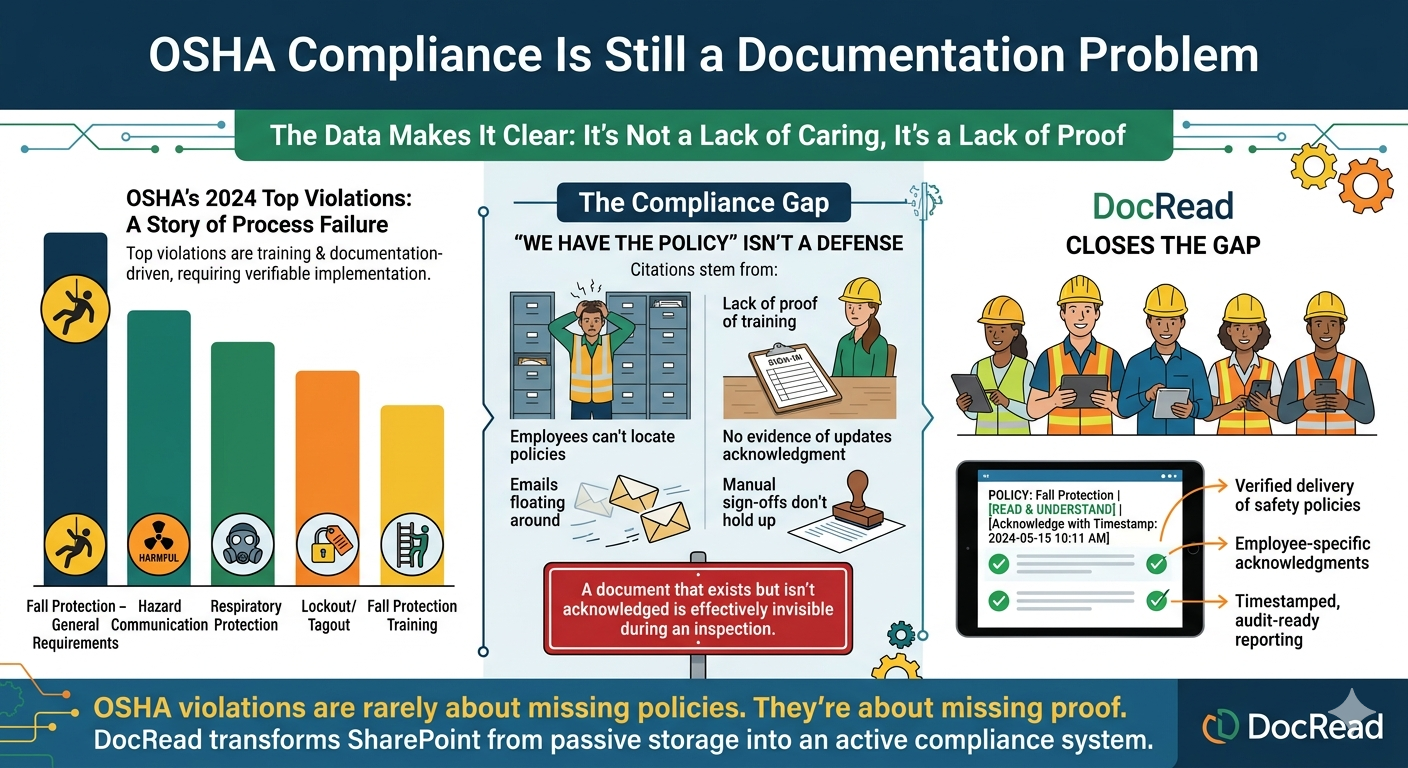
OSHA compliance isn’t failing because companies don’t care about safety. It’s failing because most organizations can’t prove that safety policies were actually communicated, read, and understood.
The data makes that clear.
What OSHA’s 2024 Data Reveals
For the 14th year in a row, Fall Protection – General Requirements topped OSHA’s most-cited standards list, with over 6,300 violations. But the real story isn’t just falls—it’s process failure.
Several of OSHA’s top violations are explicitly documentation- and training-driven:
- Hazard Communication
- Respiratory Protection
- Lockout/Tagout
- Fall Protection Training
These standards require written programs, employee training, and verifiable implementation. Simply storing policies in SharePoint doesn’t meet that bar—and inspectors know it.
Tired of reminding staff to read your company policies?
DocRead makes compliance simple
We Have the Policy” Isn’t a Defense
Most organizations already have safety policies. They’re written, approved, and stored somewhere—usually in Microsoft SharePoint.
That’s not enough.
OSHA citations often stem from
- Employees who can’t locate policies
- Lack of proof that training occurred
- No evidence employees acknowledged updates
- Manual sign-offs that don’t hold up under scrutiny
A document that exists but isn’t acknowledged is effectively invisible during an inspection.
Timestamped, audit-ready reporting
Most top-10 OSHA violations are classified as Serious, carrying penalties up to $16,550 per instance. But the real risk is a Willful violation—when OSHA believes the employer knew better and failed to act.
Fall Protection and Lockout/Tagout consistently rank among the most willfully cited standards. At that point, organizations must demonstrate documented corrective action—not intent.
Emails, spreadsheets, and sign-in sheets don’t cut it.
Turning SharePoint into a Compliance System
DocRead closes the gap OSHA repeatedly cites.
By integrating with SharePoint, DocRead provides:
- Verified delivery of safety policies
- Employee-specific acknowledgements
- Timestamped, audit-ready reporting
It transforms SharePoint from passive storage into an active compliance tool—one that aligns with how OSHA actually enforces its standards.
Are your policies read on time and by the right people?
DocRead makes compliance simple
The Bottom Line
OSHA violations are rarely about missing policies. They’re about missing proof.
DocRead gives organizations a defensible way to show that critical safety information wasn’t just stored—but read, acknowledged, and acted on.
That difference matters when inspections happen.
Get your free Standard Operating Procedures guide
Creating Standard Operating Procedures for your organisation doesn't have to be complicated. This guide will introduce you to the whole lifecycle from creation to training and distribution.
You may also like:
April 3, 2026
March 27, 2026
Cost Reduction Is a Leadership Skill Cost reduction is usually framed as a finance ...
March 13, 2026
Cost Reduction Is a Leadership Skill Cost reduction is usually framed as a finance ...
February 12, 2026
ConvergePoint vs Xoralia vs DocRead: A Real-World Policy Management Comparison If your organization uses ...
February 6, 2026
How DocRead Supports HIPAA Compliance in Healthcare The Health Insurance Portability and Accountability Act ...
November 28, 2025
How DocRead Supports HIPAA Compliance in Healthcare The Health Insurance Portability and Accountability Act ...